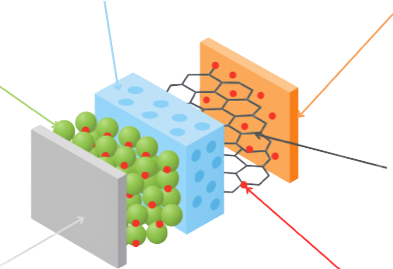
The operation of a lithium-ion battery relies on the reversible movement of lithium ions (Li⁺) between the two electrodes.
In charge
The ionsLi⁺ leave the cathode → cross the electrolyte → insert into the’anode Graphite.
The electrons² follow an external path, supplying power to the device or charging station.
1 An atom or group of atoms that is electrically charged as a result of an increase or decrease in the number of electrons. ² : Particle carrying a negative elementary electric charge.
At the dump:
The process is reversed: Li⁺ ions migrate from the’anode to the cathode, generating a usable electric current.
This mechanism is based on:
The Crystal structure3
Allows the insertion/removal of ions.
3 An ordered and periodic arrangement of ions in a solid, determining its physical properties and shape.
The Tension4 high (≈ 4.2 V/cell)
Made possible by the’Organic electrolyte.5
4 The potential difference existing between the two poles of a set and measured in volts.
5 A substance which, when dissolved in water, dissociates into charged ions, thereby enabling it to conduct an electric current.