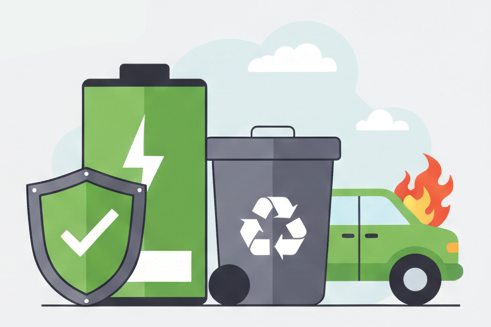
Storage best practices
Lithium batteries can be damaged over time by heat, humidity, shocks, or improper use. Internal damage can lead to thermal runaway (rapid production of heat, flammable gases, and flames).
Why is this important?
This phenomenon is particularly dangerous at home, as a fire can spread very quickly in an enclosed environment filled with combustible materials (furniture, textiles), leaving very little time to react.
- To do:
- Store the battery in a cool, dry and ventilated place, away from any heat source (> 40°C).
- Place the battery on a hard, non-flammable surface (tiles).
- Maintain an intermediate charge (30–60%) in case of prolonged storage.
- Protect the terminals with insulating tape if the battery is not inserted in the device.
- Regularly check the condition of the battery (swelling, odor, abnormal heat).
- To avoid:
- Storage in a closed, unventilated garage, a car in summer, a hot attic, a damp room.
- Contact with metallic objects (risk of internal short circuit).
- Storage in close proximity to textiles, cardboard, wood, solvents or combustible waste.